

Blog
How to Set Up a Watch Winder: TPD, Rotation Direction and Winding Modes, Step by Step

Quick Answer
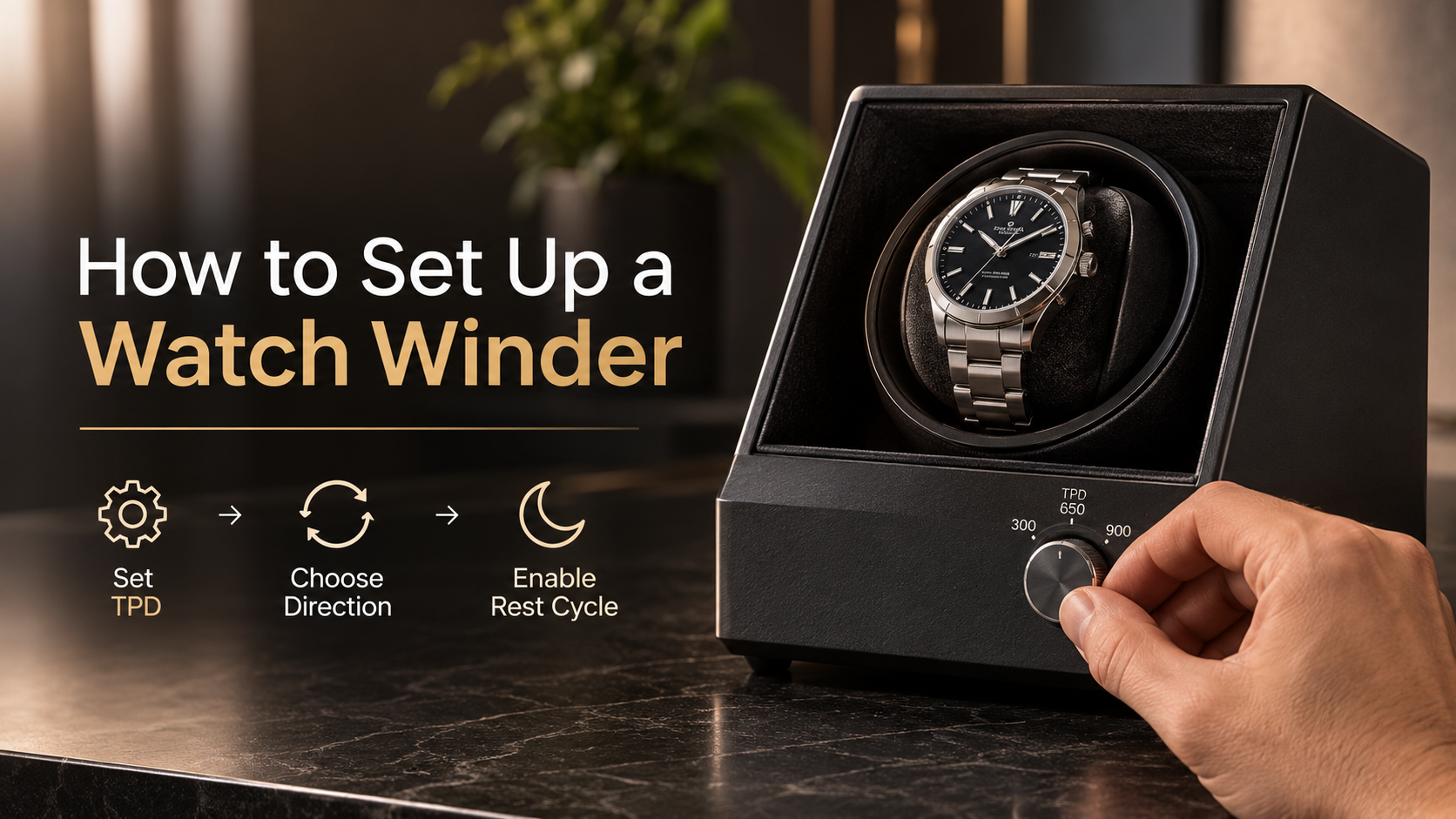
To set up a watch winder, wind and set the watch by hand first, mount it securely on the cushion, then enter the turns per day (TPD) and rotation direction recommended for its movement. Choose a program with rest periods, and check over 48 hours that the watch keeps its power reserve. No single setting suits every watch.
A new watch winder usually arrives with a short manual, a row of switches or a touchscreen, and a list of programs with names like “650 BI” or “900 CW”. It is easy to pick one and hope. It is just as easy to get it right in about ten minutes, once you know what each setting does and in what order to set them.
Whether you have just unpacked a new automatic watch winder or are setting up an extra watch on an existing one, this guide walks through the process step by step, explains what the modes mean, and shows how to check that your settings are working.
Watch winder settings at a glance
Three settings control how a winder treats a watch.
| Setting | What it means | What to set |
| Turns per day (TPD) | The total number of full rotations the winder makes in 24 hours | The figure recommended for your watch’s movement |
| Rotation direction | Clockwise (CW), counterclockwise (CCW) or bidirectional (alternating) | The direction your movement winds in |
| Program or mode | How the winder spreads those turns over the day: rotation periods followed by rest periods | A program that includes rests; some winders also offer modes for display or day/night |
TPD and direction depend on the movement, not the winder. For a deeper explanation of both, see our guide to what TPD and rotation direction mean.
How to set up a watch winder, step by step
Step 1: Place the winder and connect power
Put the winder on a flat, stable surface away from direct sunlight, heat and moisture. Use the adapter supplied with the winder, or batteries if it supports them. Many manuals ask you to switch the winder off before inserting or removing a watch, and not to turn the drum by hand.
Step 2: Wind and set the watch first
A winder is designed to maintain a watch’s wind, not to start a fully stopped watch from empty. Winder manuals from brands such as Mainspring London ask you to wind the watch manually before placing it in the winder, because its reserve may not be enough on its own. Wind it by the crown following your watch’s manual, then set the time and date.
If your watch cannot be hand-wound, as with some movements such as Seiko’s 7S26, wear it or move it gently until it is running before mounting it.
Step 3: Mount the watch securely
Close the strap or bracelet around the cushion so the watch sits snugly without straining the clasp. On most winders the case back rests against the cushion and the strap wraps around it. Make sure nothing hangs loose that could catch as the drum turns.
Step 4: Find your watch’s TPD and direction
Look these up rather than guessing:
- Your watch’s manual or the manufacturer’s website. If they publish a recommendation, use it.
- A reputable winding database. Orbita’s watch database is widely cited by collectors. Barrington and Rotation Horlogère also publish lookup tables; Rotation Horlogère’s covers more than 5,800 references from 86 brands.
- Your movement (caliber) name. If you know it, for example from the caseback or the manual, search the caliber name with “TPD”.
- The brand’s customer service or a watchmaker if you still cannot find it.
Recommendations differ between sources and between models from the same brand, so check the specific reference or caliber, not just the brand.
Step 5: Enter the settings
The method depends on the winder: DIP switches (Orbita, for example, uses these), a dial, buttons with an LCD, a touchscreen or a remote. Enter the TPD and direction for each position. On a multi-watch winder, check whether each position can be set separately. If positions share one program, group watches with similar requirements together.
Step 6: Choose a program with rest periods
Good winders do not rotate continuously. They turn for a short period, then rest, and repeat through the day; Barrington gives the example of turning for about a minute, then resting for 10–15 minutes. Your TPD is the result of how fast the drum turns and how long it turns in total each day. Choose a program that includes rests unless your manual says otherwise.
Step 7: Close the lid and check over 48 hours
Run the winder for a day or two, then check the watch:
- Is it still running and keeping good time? If yes, the settings are probably working.
- If it has a power reserve indicator, check that it stays at or near full. Seiko’s manuals, for example, suggest checking the indicator to see whether the watch has enough power stored.
- If it stops or the reserve drops, check the direction first, then raise the TPD gradually within the range recommended for your watch.
What are watch winder modes?
Winder makers use different names, but most programs fall into a few types:
| Mode type | What it does | When it is used |
| Fixed-TPD programs (e.g., “650 CW”, “900 BI”) | A preset number of turns per day in one direction or alternating | Most everyday winding |
| Bidirectional or alternating | Rotates one way, then the other | Movements that wind in both directions |
| Rest or sleep cycles | Pauses between rotation periods | Built into most programs; some winders let you adjust them |
| Delayed start | Waits before starting the first cycle | A watch that has just come off the wrist and is already well wound |
| Display or continuous modes | Rotate for show | Display only; check your manual before using them for daily winding |
The exact modes depend on the model, so your winder’s manual is the reference. For background on how the rotor and mainspring respond to rotation, see our explainer on how automatic winding works.
Can incorrect watch winder settings cause problems?
Incorrect settings usually cause inconvenience rather than damage.
- TPD too low: the watch gradually loses its reserve and may stop or lose time.
- Wrong direction: if the movement winds in only one direction and the winder turns the other way, the rotor moves but does not wind the mainspring, and the watch runs down.
- TPD too high: automatic movements use a slipping mainspring (bridle) that slips when fully wound, so a high setting does not overwind a healthy watch. Seiko’s manuals note that the mainspring slips once fully wound. It does mean more rotation than the watch needs, which is why it makes sense to use the recommended figure rather than the maximum.
If a watch runs poorly even with correct settings, the issue may be the watch itself, and a watchmaker should check it.
Common watch winder setting mistakes
| Mistake | What happens | Fix |
| Mounting a fully stopped watch | It may not build enough reserve | Wind it by hand first |
| Wrong direction for a unidirectional movement | The watch runs down | Look up the direction and correct it |
| Using one setting for every watch | Some watches are under-wound | Set each position separately, or group similar watches |
| Running nonstop | Unnecessary rotation | Choose a program with rest periods |
| Guessing from the brand only | Models within a brand can differ | Look up the specific caliber or reference |
| Forgetting the time after mounting | The watch is running but wrong | Set the time and date before mounting |
Troubleshooting: why does my watch stop on the winder?
| Symptom | Check first | Then |
| Watch stops overnight | Direction setting; whether it was wound before mounting | Raise TPD gradually within the recommended range |
| Watch runs but loses time | Whether it is fully wound; settings | If it persists at correct settings, have the watch checked |
| One position works, another does not | Swap the watches between positions | If the problem follows the position, contact the winder seller |
| Winder not turning | Power, batteries, lid closed, delayed-start mode | Contact support if it still does not turn |
How to choose a watch winder with suitable settings
If you are choosing a winder, look for:
- Adjustable TPD across a range wide enough for your watches.
- Three direction modes: clockwise, counterclockwise and bidirectional.
- Independent settings per position on multi-watch units.
- Programs with rest periods.
- A clear manual that explains each mode.
The Aerion L502, for example, lists four independently controlled positions, TPD adjustable from 300 to 2,300, and clockwise, counterclockwise and alternating rotation.
Frequently asked questions
What is the ideal TPD for an automatic watch?
There is no single ideal TPD. The right figure depends on the movement. Use the manufacturer’s recommendation or a reputable winding database for your specific caliber.
Should I wind my watch before putting it on a winder?
Yes. Winder manuals commonly advise winding the watch by hand first, because a winder is designed to maintain a watch’s wind rather than to wind a stopped watch from empty.
Is clockwise or counterclockwise better?
Neither is better in general. Use the direction your movement winds in. Many movements wind in both directions; some wind in only one.
What does bidirectional mean on a watch winder?
The winder alternates between clockwise and counterclockwise rotation. It suits movements that wind in both directions.
How often should a watch winder rotate?
It depends on the program. Most winders rotate in short periods followed by rests, adding up to the TPD you set over 24 hours.
Can wrong winder settings damage my watch?
Usually not. Too low a TPD or the wrong direction lets the watch run down. A slipping mainspring prevents overwinding at high settings, but there is no benefit in using more turns than recommended.
How do I know my settings are correct?
After 48 hours on the winder, the watch should still be running, keeping good time, and, if it has a power reserve indicator, showing a strong reserve.
Conclusion
Setting up a watch winder well comes down to order: wind and set the watch, mount it securely, look up its TPD and direction, enter them, choose a program with rests, and check after 48 hours. The settings belong to the movement, not the winder, so the watch manufacturer’s guidance always comes first. Once set, a winder should simply keep your watch running and ready to wear.